
Banjara Matrimony made free for the Banjara community. Find verified Banjara brides & grooms across India on BanjaraMatch.com.
Banjara Matrimony made free for the Banjara community. Find verified Banjara brides & grooms across India on BanjaraMatch.com.
 Free Banjara Matrimony


The complete story of India's largest nomadic trading community — the Banjara people (also known as Lambadi, Gormati, Lambani, and Sugali). From ancient Rajput origins to today's 3 crore strong community spread across India.
The Banjara are one of India's most widespread and historically significant nomadic communities. With a population of over 3 crore (30 million) people, they are present in nearly every state in India, but concentrated in Telangana, Andhra Pradesh, Maharashtra, Karnataka, Rajasthan, Madhya Pradesh, Gujarat, and Delhi.
The community is known by different names depending on the region: Lambadi or Lambada in Telangana and Andhra Pradesh, Lambani in Karnataka, Gormati or Gor Banjara in Maharashtra, and Sugali in parts of Andhra Pradesh. Despite different names, all these groups share the same ancestors, the same language roots (Gor Boli), and the same gotra system.
Historically, the Banjara were India's most powerful land-based trading community — transporting salt, grain, cotton, and military supplies across the subcontinent using massive caravans of oxen (called tangas). Their role in supplying armies during the Mughal and Maratha periods was so significant that the community is credited with keeping armies — including Aurangzeb's — supplied across thousands of kilometres.
The most widely accepted theory among historians and the Banjara community itself is that they are descended from Rajput clans who migrated southward and eastward from Rajasthan between the 12th and 16th centuries — driven by the collapse of Rajput kingdoms following Islamic invasions and the disruption caused by the Delhi Sultanate.
The strongest evidence for Rajput ancestry is in the gotra (clan) system. Banjara gotras such as Rathod, Chavan, Pawar, Bhosale, Jadhav, and Tanwar directly correspond to major Rajput clans. The community also follows Rajput customs of clan exogamy, venerates Rajput warriors, and traces lineage through a patrilineal system identical to Rajput genealogy.
The term Banjara itself is believed to derive from the Sanskrit Vanijyakara (वाणिज्यकार) meaning "trader" or "one engaged in commerce" — reflecting their historical role as nomadic merchants.
One of the most remarkable discoveries in anthropological research is the linguistic and genetic connection between the Banjara community and the Roma (Romani) people of Europe — commonly known as Gypsies.
Linguistic analysis shows that Gor Boli (the Banjara language) and Romani (the European Roma language) share a significant core vocabulary — words for body parts, family relationships, numbers, and everyday objects are virtually identical. DNA studies have further confirmed that the Romani people's closest genetic relatives in South Asia are groups from north-west India, including communities like the Banjara.
This strongly suggests that the ancestors of today's European Roma and today's Indian Banjara were once part of the same population, which split when some members began migrating westward from India around 900–1100 CE.
Research note: The linguistic overlap between Gor Boli and Romani was first formally documented by Dr. Ian Hancock (University of Texas) and further confirmed by multiple genetic studies published in journals including Nature and PLOS ONE.
Ancestors of the Banjara live in what is today Rajasthan and Gujarat. Evidence of nomadic pastoralism and overland trade. The community's oral history speaks of descent from Gor — a revered ancestor figure.
A branch of the ancestral Banjara population begins migrating westward through Persia and into Europe — eventually becoming the Romani (Roma/Gypsy) people. Those who remain in India continue their nomadic trading life across the subcontinent.
The Banjara emerge as India's dominant land-based trading community. Using massive caravans of bullocks called tangas, they transport salt, grain, cotton, and spices across the Deccan, Gangetic plains, and central India. A single Banjara tanda could have 1,000–10,000 bullocks.
The Banjara become essential military suppliers for Mughal armies. Historical records note that Aurangzeb's military campaigns in the Deccan (1680s–1707) were substantially supported by Banjara supply chains transporting food and ammunition across central India. The community's leader Lachhiram Banjara is mentioned in Mughal court records.
The Banjara provide critical logistics for the Maratha Confederacy. Peshwa records document extensive Banjara involvement in supplying Maratha armies during their expansion across India. Many Banjara leaders received land grants from Maratha rulers in recognition of their services.
The British East India Company's introduction of railways and road networks begins displacing bullock-cart caravans. Banjara trading power declines sharply as their monopoly on overland trade is broken. The community begins transitioning from trade to agriculture and wage labour.
Banjara fighters participate in the 1857 uprising against British rule in several regions. The community's resistance is documented in central Indian and Deccan records. Banjara leaders in Nanded (Maharashtra) and parts of Telangana actively resist British forces.
The British classify the Banjara under the Criminal Tribes Act of 1871 — branding the entire nomadic community as hereditary criminals. This act led to mass surveillance, forced settlements, and severe restrictions on movement. The trauma of this period still shapes community memory.
After Independence, India repeals the Criminal Tribes Act. The Banjara are "de-notified" — no longer classified as criminals. Many states begin recognising the Banjara as Scheduled Tribes (ST), opening access to reservations in education and government employment.
The Banjara community gains significant political representation. Seethakka (MLA, Telangana), Bandaru Dattatreya (Governor), and other leaders rise to prominence. The community pushes for ST status across all states. Cultural organisations work to preserve Gor Boli language, Tanda traditions, and Banjara embroidery art forms.
The Tanda is the foundational social unit of the Banjara community. The word originally referred to the mobile caravan of bullock carts that Banjara traders used to travel across India. As the community settled, the Tanda transformed into a permanent settlement — a cluster of Banjara households living together, usually on the periphery of a larger town or village.
Every Tanda is led by a Tanda Nayak (also called Tanda Patel) — the elected or inherited head of the Tanda who resolves disputes, represents the community in dealings with local government, and maintains social order. The Nayak's word carries great authority within the Tanda.
Within the Tanda, marriages, funerals, festivals, and all major community decisions are made collectively. The Tanda Panchayat — a council of elders — has traditionally governed disputes over marriage compatibility (especially gotra conflicts), inheritance, and social violations.
Gor Boli (also written as Gorboli, Lambadi, Banjari, or Lambani) is the native language of the Banjara community. It belongs to the Indo-Aryan language family and has its roots in old Rajasthani dialects mixed with Sanskrit vocabulary.
The language has no standardised script of its own — it has historically been written in Devanagari, Telugu, Kannada, or Marathi script depending on the region. Efforts to standardise a dedicated Gor Boli script have been made by community scholars but no single standard has been universally adopted.
Regional dialects exist across states. The Gor Boli spoken in Telangana has heavy Telugu influence. The Lambani dialect of Karnataka has Kannada borrowings. The Gormati dialect in Maharashtra has Marathi vocabulary mixed in. Despite these regional variations, all Banjara speakers can generally understand each other.
| English | Gor Boli | Romani Equivalent |
|---|---|---|
| Water | Paani | Pani |
| Hand | Hath | Vast |
| Mother | Aai / Dhai | Daj / Dej |
| Fire | Yak / Agni | Yag / Jag |
| Road | Drom | Drom |
| Black | Kalo | Kalo |
Note: "Drom" (road) and "Kalo" (black) are nearly identical in Gor Boli and Romani — strong evidence of shared ancestry.
The Banjara community has one of the richest and most visually distinctive cultures in India. From their embroidery to their festivals to their music, Banjara traditions are instantly recognisable and deeply meaningful.
The most iconic Banjara art form. Women embroider their clothing, bags, and wall hangings with geometric patterns in bright colours — red, yellow, green, and blue — using mirrors (shisha), beads, and cowrie shells. Each embroidery pattern has meaning and varies by region.
Seeta Mata is the primary deity of the Banjara community. Every Tanda has a Seeta Mata shrine, and the Seeta Navratri (nine nights of worship) is the most important festival observed by Banjaras across all states. Communities gather for community feasts, dance, and music.
Banjara music is vibrant and energetic. Traditional instruments include the dholak (drum), tumba (a one-string instrument), and pungi (flute). Women perform the traditional Dhariya dance at weddings and festivals, accompanied by group singing in Gor Boli.
Traditional Banjara women wear heavy silver jewellery — large necklaces (hasli), bangles, ankle chains, and head ornaments. The jewellery is not decorative alone — it represents wealth, status, and family identity. Banjara silver jewellery has become internationally recognised as a distinctive art form.
Banjara women traditionally wear a distinctive kachchi (ghagra-style skirt) with heavy embroidery, a decorated blouse, and a covered head with embroidered fabric. The clothing is unmistakable — bright, layered, and covered in mirrors and beadwork. Traditional dress is still worn at festivals and ceremonies.
Traditional Banjara food reflects their nomadic heritage — simple, portable, and high-energy. Bajra (pearl millet) roti, wild greens, and dal are staples. Meat (mutton and chicken) is common. A traditional Banjara feast (Seeta Mata pooja prasad) includes collective cooking and communal eating.
The Banjara community is present in nearly every Indian state, but the following states have the largest populations and where the community has ST recognition.
Largest state population. ST status. Significant political representation — Seethakka, Bandaru Dattatreya. Concentrated in Nizamabad, Karimnagar, Nalgonda, Adilabad districts.
ST status. Large population in Kurnool, Kadapa, Nellore, Krishna, and Guntur districts. Sugali is a major sub-name used in AP.
ST status. Major presence in Nanded, Nagpur, Aurangabad, Nashik, Amravati, Yavatmal. The Gormati/Gor identity is strongly maintained.
ST status. Concentrated in Bellary, Bidar, Raichur, Belgaum, Dharwad, Mysore. Known for their distinct Lambani embroidery art style.
Historical homeland. OBC/ST status varies by district. Present across Jodhpur, Barmer, Jaipur, Nagaur. The community traces ancestral roots to this state.
ST status. Large presence in Betul, Hoshangabad, Chhindwara, Bhopal, Vidisha districts. Significant rural Tanda communities.
ST status. Present in Banaskantha, Sabarkantha, Dahod, Panchmahals. The Gujarat Banjara maintained stronger trading traditions longer than most other states.
Large urban Banjara population due to migration from Rajasthan, UP, and Haryana. Several Banjara Tanda communities in outer Delhi districts.
Members of the Banjara community have risen to prominent positions across politics, sports, literature, and public life.
One of the most prominent Lambadi/Banjara politicians in India. MLA from Mulugu, Telangana. Known for her grassroots work, distinctive Banjara attire in legislative sessions, and advocacy for tribal and Banjara rights.
From the Banjara community, served as Union Labour Minister and Governor of Himachal Pradesh and Haryana. One of the community's most prominent national political leaders.
Former Home Minister of India and Chief Minister of Maharashtra. From the Banjara/Gormati community. Served multiple terms in Parliament and held several senior Cabinet positions.
The most famous Banjara historical figure. A powerful trade leader who commanded massive bullock caravans supplying Mughal armies. Mentioned in Mughal court records for his role in supplying Aurangzeb's Deccan campaigns.
One of the first Banjara/Lambadi women to clear the UPSC civil services examination and serve as an IAS officer. A role model for young Banjara women across India pursuing professional careers.
Telugu film actress from the Banjara/Lambadi community who has been vocal about her community identity and has worked to bring Banjara stories and culture to mainstream Indian cinema.
In Banjara tradition, marriage is one of the most important events in community life. The gotra system strictly governs who can marry whom — same-gotra marriages are forbidden across all branches of the community. Cross-cousin marriages (marrying a maternal uncle's daughter) are acceptable in some regional traditions.
BanjaraMatch was built specifically to serve the Banjara community's matrimonial needs. It is India's first free Banjara matrimony platform, with gotra-based filtering built in from registration — so every match suggestion you see is already gotra-compatible.
The Banjara are a nomadic community of India with an estimated population of over 3 crore (30 million). They are known by different names across India — Lambadi in Telangana and Andhra Pradesh, Lambani in Karnataka, Gormati in Maharashtra, and Sugali in some parts of AP. Historically, they were the largest trading and transport community in pre-colonial India, carrying salt, grain, and goods across the subcontinent using large caravans of bullocks.
The most widely accepted theory is that Banjara descended from Rajput clans who became nomadic traders after the fall of Rajput kingdoms in Rajasthan between the 12th and 16th centuries. Their gotras (clans) like Rathod, Chavan, Pawar, and Jadhav match major Rajput clan names. Some scholars also suggest connections to ancient Romani people who migrated from India to Europe around the 11th century.
The Banjara community speaks Gor Boli (also called Lambadi, Banjari, or Gorboli), a distinct language with roots in old Rajasthani and Sanskrit. It has significant vocabulary overlap with Romani (the language of the European Roma people). Regional dialects exist — Telangana's dialect has Telugu influence, Karnataka's has Kannada, Maharashtra's has Marathi — but all are mutually intelligible.
A Tanda is the traditional settlement unit of the Banjara community — originally a mobile caravan, today a permanent settlement of Banjara families. Every Tanda has a Tanda Nayak (leader) and a Tanda Panchayat (council of elders) that governs community affairs including marriage compatibility, disputes, and ceremonies.
The Banjara community has an estimated population of over 3 crore (30 million) people in India. They are classified as Scheduled Tribe (ST) in several states including Andhra Pradesh, Telangana, Karnataka, Maharashtra, Madhya Pradesh, Rajasthan, and Gujarat. Telangana and Andhra Pradesh have the largest Banjara/Lambadi populations.
The vast majority of the Banjara community follows Hinduism, with their primary deity being Seeta Mata. They observe Hindu festivals including Navratri (with their own Seeta Navratri tradition), Diwali, and Holi. However, the Banjara religious practice is distinct — it blends mainstream Hindu practice with specific Banjara traditions and deities unique to the community. A small minority has converted to Christianity or Islam in certain regions.
The word "Banjara" is believed to derive from the Sanskrit "Vanijyakara" (वाणिज्यकार) meaning "trader" or "one engaged in commerce" — reflecting their historical role as nomadic merchants. Another theory suggests it comes from "ban" (forest) and "chara" (wanderer), describing their nomadic forest-dwelling lifestyle. The community also refers to itself as "Gor" — a term of pride meaning the original or pure people.
BanjaraMatch is India's first free Banjara matrimony platform. Gotra-compatible matches, verified profiles, 100% free.
Register Free on BanjaraMatch View Gotra List Tips - BanjaraMatch Team
Not every mismatch is a red flag, and not every red flag is obvious in a single meeting. Here is a practical, no-nonsense guide to telling t…
Read more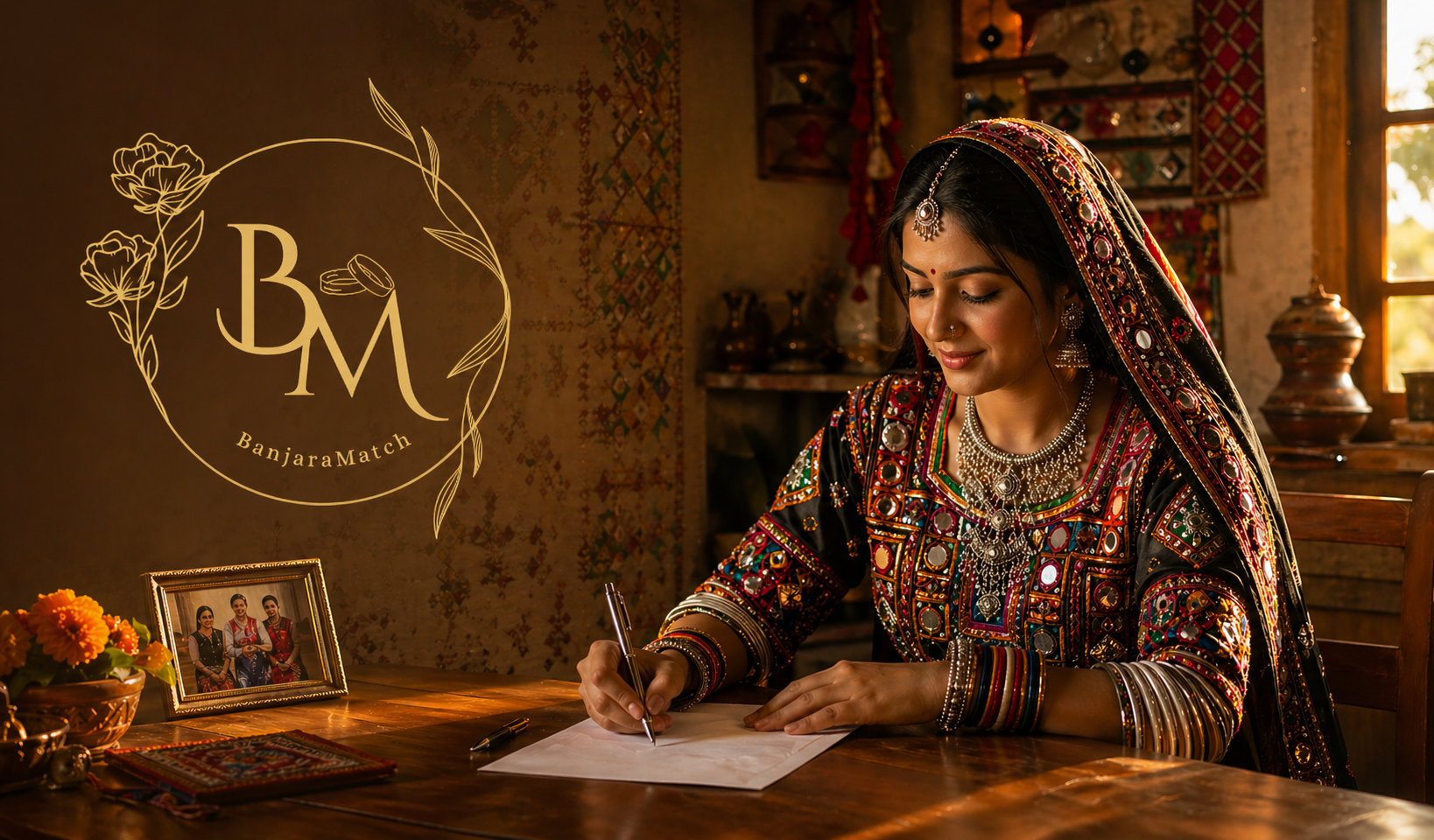 Tips - BanjaraMatch Team
A step-by-step guide to writing a Banjara marriage biodata that makes families take you seriously — covering gotra, family background, photo…
Read more Culture - BanjaraMatch Team
A complete guide to Banjara gotras, same-gotra restrictions, the seven-generation rule, and how to use gotra matching on BanjaraMatch to fin…
Read moreBanjaraMatch - India's First Free Banjara Matrimony Platform. Join us today!
This website is strictly for matrimonial purposes only and not a dating website.
A safe, non-discriminatory, non-exploitative matchmaking service for adults aged 18 years and above seeking committed marriage relationships.
Copyright © 2026 BanjaraMatch.com. All rights reserved.
